
Hellmout Magazine reports on the Minneapolis Artist Response
Artists on the Minneapolis Frontline Full story on Substack click here
Minneapolis Response HELLMOUTH MAGAZINE AND KELLY FERGUSON FEB 10, 2026
A little background for this reposted story. Many Arts District board members have reached out to other arts districts and communities when traveling. Board Chair Josh Blanc was in Knoxville, Tennessee, three years ago and found an art community and an artist, Kelly Ferguson. They had corresponded a few times, but when the siege of Minneapolis was at its height, she reached out to write about our arts district and share it with their audience. Below is the section that Kelly wrote about the artists’ response to the Federal government’s ICE Operation Metro Surge. Interviewing Josh Blanc and Seth Stattmiller. Kelly’s reporting is useful and insightful to know how other communities see ours.
Minneapolis community activist Khalid Mohammed has been leading protests and delivering groceries to those sheltering in place for weeks. He is especially focused on the rights of Somali citizens—a group which is bearing the brunt of this current raid due to a viral video alleging fraud by Somalian-run daycares.
Mohammed explained the environment to Channel 4 news, saying, “The moment you physically look like a Somali, that is when the harassment starts. Being Somali here is a crime under the federal government.”
He has experienced first-hand the backlash of exercising his First Amendment rights, explaining that “I never thought I would be tear-gassed and pepper-sprayed by my own government.”
His young children express a similar dismay at the rise in hate, commenting, “It’s like COVID, it’s spreading all around. They’re making America not great anymore.”
Another Minneapolis resident, Aliya Rahman was arrested and denied urgent medical care while detained. She reports “horrific conditions” in the Whipple Detention Center and that the people imprisoned there are being referred to as “bodies.”
“You have no reason to believe you will make it out alive if you are already being called a body,” she said.
The stories of ICE’s actions worsen daily. It’s hard to keep up with the barrage of crimes against humanity. This rapid devolvement into vengeful authoritarianism is a tactic to overwhelm dissenters into a state of action paralysis. Operations are named with battleground terminology, like in Chicago’s “Operation Midway Blitz”, a title all too reminiscent of the Blitzkrieg—a technique meant to “cause shock and disorganization”.
Fascism, white nationalism, and religious oligarchy have been welcomed into the public sphere, accepted by many as good leadership for the United States’ longevity and prosperity. Others, though they would prefer less violent enforcement of deportation, simply shake their heads. The news exists in their phones, not on their front doorstep.
This has opened the door to a cascade of power-grabbing which resembles a coup. ICE takes on the role of a private militia, serving the President’s specific commands like the Gestapo to remove those they consider undesirable at will. It’s not the first time America has acted in this way, though through muddied history it is easily forgotten as a white-washing of the country’s idealistic image. The Trail of Tears forcibly removed indigenous people from their ancestral homes in order for white settlers to take over the land, a governmental edict which resulted in the death of thousands of indigenous people. This was just one instance in the federally-led genocide of Native Americans. Slave patrols, established as “a system of terror” to discourage uprisings from enslaved people, are the origin of modern day policing. They enforced restrictive laws against BIPOC people through use of brutality and excessive force—a phrase familiar to modern ears.
This current moment is no ‘unprecedented time’ for the States, yet violence like this is systematically erased. Dismissed as history, atrocities like the killing of George Floyd, Ahmad Aubrey, Breonna Taylor, and now Pretti and Good have brought these ugly truths back to the forefront where the situation cannot be ignored.
America has taken notice. National protests swelled, especially after the killing of Renée Good, a 37-year-old mother and poet, and Alex Pretti, a 37-year-old intensive care nurse, even as the number of BIPOC killed by ICE or in ICE custody is much higher. The January 30 national walkout, strike, and economic blackout projected 300 protests planned across the country.
Locally in Knoxville, Knox County high school students organized a protest that resulted in an estimated 1,650 people marching to City Hall. The demographics shifted noticeably younger, with children as young as elementary schoolers shouting at the top of their lungs, a response specifically to the threat of ICE infiltrating private safe spaces like churches and schools.
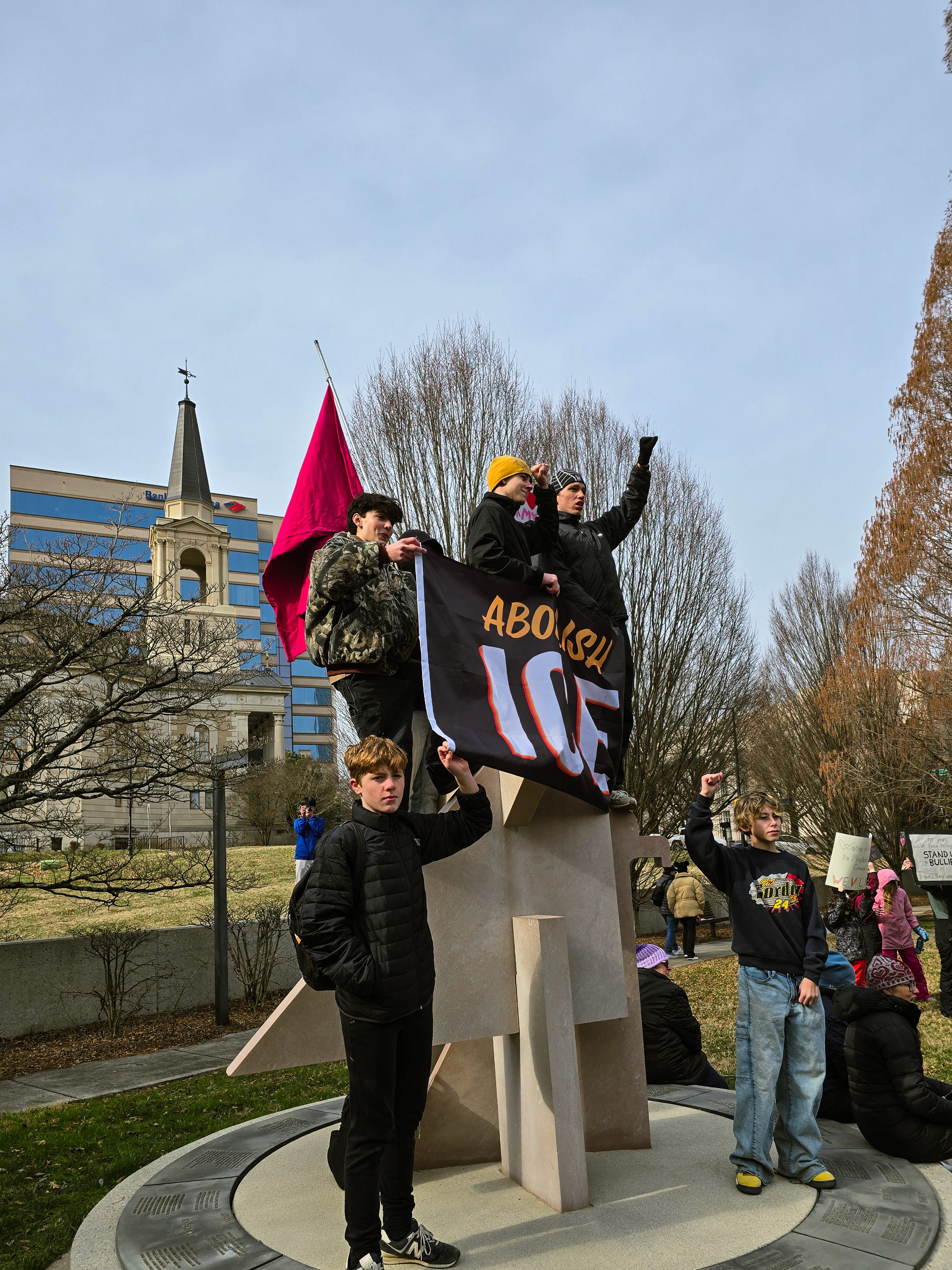
Minneapolitans, though in a collective mourning, are coming together. In immigrant communities, arts communities, and regular neighborhoods, people are looking out for each other.
“It’s called Minnesota nice,” community and faith leader Abdullahi Farah told Channel 4. “It’s the hospitable nature of our [Somali] community as well. We’ve been here for the last thirty years. The neighbors and co-workers and people know who the Somali community are here. They don’t need Donald Trump to tell them who their Somali neighbor is.”
“We come to the aid of those in trouble,” an anonymous man said. He arrived legally to the U.S. a year ago, though he is still in hiding for fear of detainment. “Those who have resources give to those who don’t. Those who are afraid are supported by those who aren’t. They stand by each other—the Somalis and other immigrants living here in Minnesota.”
Though there is chaos, Minneapolis residents are unified in their actions, finding solidarity and support especially through the arts. In a city where the “streets bear a memory of violence,” as Brourman said, the people there are prepared to defend their neighbors.
Six years ago, people took to the streets to protest the murder of George Floyd in 2020, and painted murals to honor his memory. Hellmouth Magazine spoke with Josh Blanc, Chair of the Northeast Minneapolis Arts District, to find out how the art community is reacting to the situation.
“There is a lot of camaraderie in the city,” Blanc said.
He’s among many stepping up and outside, onto the sidewalks where people stand at every corner in the freezing weather, patrolling for ICE. Neighbors in the northeast area patrol Central Avenue, keeping a watchful eye and blowing whistles to alert others of sightings. It’s a collective effort that strengthens as it grows. People who may not have engaged with such activism before are encouraged by the presence of others to get involved.
“You feel like you’re not the only one doing this,” Blanc said. “A lot of times you’re screaming into the ether, ‘hey, come on, get into this.’ And nobody’s responding to you. This time people are responding.”
However, he pointed out that “you’re not gonna get a lot of people forever,” and that it’s these moments of action with a surge of attention that drive people to stand up for democracy.
“The mass majority of the population is like that,” Blanc explained. “They either don’t want to talk about it or don’t want to engage in these things, but sometimes, when it gets close to people they start to realize ‘Oh, this is not on television, it’s not Instagram. It’s a real thing,’ and they can feel it and see it.”
But it’s not just people newly spurred to action who are leading the call for justice. Long-term community building efforts bolster the connection between neighbors and provide a solid foundation on which the movement grows.
Recovery Bike Shop owner Seth Stattmiller has been organizing weekly meetup events he calls “Coffee Outside” since before the Surge as a simple way to build community. That phrase ‘build community’ is a repeated imperative, which without concrete implementation can lead to an abstract understanding of exactly what that is.
For Stattmiller, it looks like a casual weekly coffee meetup with no particular agenda except to get to know people and share conversation. Every week, they gather in front of a different business, which after an hour of coffee and chatting, they will often go in and support. Something as simple as a routinely shared space allowed connections to solidify organically. When the circumstances required people to band together, they were ready.
“As soon as this ICE activity ramped up here, everybody started to help and look for ways to be involved, but especially ways to connect,” Stattmiller said.
Now, after their coffee meetups end, “people will go patrol, walking up and down the street, keeping an eye out for ICE, helping people feel safe.”
“The very fact of being visible is activism. Just showing our community that people are out here standing up for this, makes it more comfortable for more people to come out and stand up. It’s eyes on the street.
“If you’re the only person standing on a cold dark street, that can be a really scary experience. But if there’s a crowd of people, you can handle threats and feel comfortable. Part of it is just a part of being a presence on Central Avenue that makes our neighbors feel more comfortable, but also lowers the temperature of everybody’s anxiety and hopefully de-escalates the situation.”
Legal observers wear whistles to signal an ICE sighting, and wearing one has become a sign of solidarity whether a person is patrolling or not. People making their own whistles have brought over a dozen variations to the bike shop for Stattmiller to distribute.
“We’re bringing whistles to a gun fight,” he said. “It feels like this is happening to Minneapolis, and certainly, we’re feeling it more than other places, but this is happening to this whole country. This is happening to the whole world. Everyone is watching and this is our opportunity to draw the line and say this isn’t right and we’re gonna stop this now.”


